
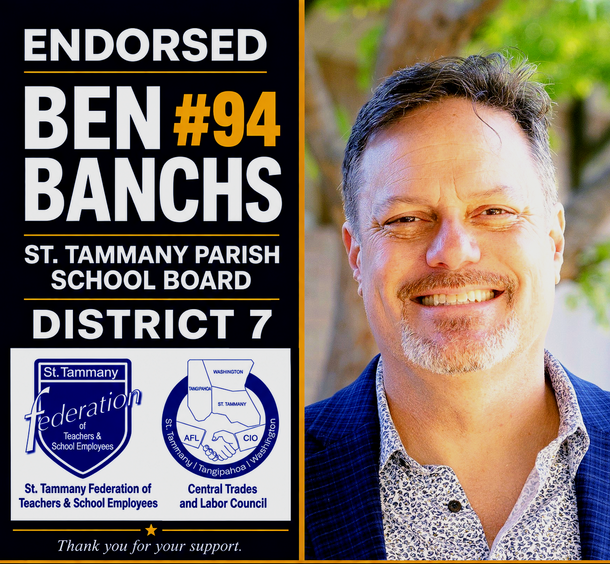
Hello, My Name is Ben Banchs
Proud Husband, Father, Veteran, and St. Tammany Resident
First, thank you for giving me the opportunity to share a little about who I am and why I want to serve as your School Board Representative.
I first moved to Louisiana in 1985 and have proudly called St. Tammany Parish home since May 2005. I come from a family with a strong tradition of public service. My father, a Vietnam veteran, served in the Marine Corps and Army before finishing his military career with the Louisiana Army National Guard. My mother was a registered nurse, and both of my parents concluded their careers at the New Orleans VA Medical Center, serving our nation’s veterans.
I have three brothers. One served in the Army, another continues to serve in the Navy, and the third supports public service through his civilian career. In our family, public service has always been more than a legacy — it is a responsibility.
I am also a product of public education. Because of my father’s military service, I attended public schools in Virginia, Georgia, Puerto Rico, and Louisiana. Our family eventually settled in Metairie, where I graduated from Grace King High School in the Jefferson Parish Public School System. Those experiences shaped my belief that a strong public education provides the foundation on which a person can build everything else, regardless of where they begin.
In February 1991, I joined the Louisiana Air National Guard and went on to serve for 27 years. I worked on F-15 fighter aircraft, first in the weapons load shop and later in avionics on the flight line, before retiring in 2018 as a Master Sergeant (E-7). During my career, I served overseas, deployed in the days following 9/11, and answered the call for nearly every major hurricane from Katrina forward, helping protect and support Louisiana families during some of our state’s most difficult moments.
Today, I serve as Business Manager of Laborers’ Local 1776, a public-employee union representing National Guard civilian employees across ten states and the territory of Guam. I have served in that role since 2010, advocating for employees, working through complex issues, managing responsibilities across multiple states, and bringing people together to find solutions.
My wife, Rhonda, and I have been married for more than 30 years, and we raised our three daughters — Bailey, Emily, and Ally — right here in St. Tammany Parish. All three attended St. Tammany public schools, including Abita Elementary and Middle School, Fontainebleau Junior High, and Fontainebleau High School. Like so many parents, we entrusted our children to this school system, and we understand firsthand how important strong public schools are to our families and our community.
Over the years, I coached my daughters’ softball teams at the Abita ballpark, helped launch Abita Springs’ first Christmas tree lighting and a Fourth of July celebration at the Trailhead, and remained active in serving our community. I currently serve as Second Vice Commander of American Legion Post 307 and chair its Children & Youth Committee. Last year alone, our Post provided more than $20,000 in scholarships and Boys and Girls State sponsorships for local students.
In my spare time, I am also a local singer who performs with the Hard Eight Band, Meteorite, and the Fontaineblues, bands that often perform throughout the Northshore and Greater New Orleans area. I also speak Spanish fluently.
My life has been shaped by public education, military service, family, community involvement, and advocacy for working people. Those experiences have taught me how to listen, how to lead, how to work with people who may not always agree, and how to stay focused on the mission. I hope to bring all of that experience to District 7.
Thank you again for taking the time to learn a little more about who I am and why I want to serve as your School Board Representative. I am ready to put my experience to work and serve every student, parent, teacher, employee, and family in our district.

Why I'm Running
To Give Back to the Community & Continue Serving the Public
I have always believed in public service, and I have dedicated much of my life to it—primarily through my service in the National Guard. If I am given the opportunity to represent District 7 on the School Board, it would be a continuation of that lifelong commitment to serving my community.
My first involvement with the St. Tammany Parish School Board came years ago, when attendance boundaries were being redrawn as Lakeshore High School prepared to open. The original proposal would have placed many local children on buses for well over an hour each day. Like many other parents, I was concerned, so I got involved. I attended the hearings, spoke up, and worked alongside other parents and community members until the Board ultimately adjusted the attendance boundaries.
The final result was not perfect, but the experience taught me something important: when people show up, speak up, and work together, they can make a difference — not only for their own families, but for their friends, neighbors, and community.
More recently, I again spoke before the School Board when it moved to cancel its employees’ collective bargaining agreement. That issue crossed political and ideological lines and brought people from throughout the community together around a shared concern: ensuring that the employees entrusted with educating and supporting our children are treated fairly and have the opportunity to maintain a reasonable quality of work life.
Those experiences helped shape what I would bring to this seat: someone who shows up, listens, asks questions, and makes decisions openly and transparently.
I am not running to fight culture wars or turn our School Board into another battleground between red and blue. We are Americans, Louisianans, and St. Tammany neighbors first. Most of the work a school board actually does is not partisan — it is about educating children, supporting employees, managing taxpayer dollars responsibly, maintaining safe schools, and making decisions that affect families throughout our community.
I hope to bring a fresh, independent perspective as a parent, veteran, taxpayer, and longtime advocate for working people, while keeping the focus where it belongs: on our students, teachers, staff, families, and community.
Standing Up for District 7 Schools
District 7 includes Bayou Lacombe Middle, Chahta-Ima Elementary, Lakeshore High School, and Monteleone Junior High. Those schools are part of the broader Lakeshore Learning Community, which also includes Woodlake Elementary and Mandeville Middle.
Our community is approaching an important crossroads. The School Board's 2024 demographic study projects the Lakeshore Learning Community to experience the largest percentage enrollment decline of any of the school system's eight learning communities over the ten-year forecast period—approximately 15.7%. That matters.
Declining enrollment can eventually lead to difficult conversations about school consolidation, closures, attendance boundaries, staffing, and the re-allocation of resources. I understand how consequential those decisions can be because an attendance-boundary fight is what first brought me before this School Board many years ago.
I believe education is one of the foundations of individual opportunity and a strong community. I want to bring new ideas, a different perspective, and a willingness to challenge assumptions when necessary so that our schools — and our community — are prepared to give the next generation every opportunity to succeed.
But representing District 7 also means listening.
I do not presume to know your concerns better than you do. I want to hear from parents, teachers, employees, students, taxpayers, and residents throughout our district. If I have the opportunity to serve you on the School Board, I will listen before I vote, explain the reasoning behind my decisions, and make every decision with the interests and input of the people I represent in mind.
That is the kind of representation I believe District 7 deserves.

St. Tammany Federation of Teachers and School Employees
My Answers to Their 2026 Candidate Questionnaire
1. Priorities and Preparation
Why are you seeking election to the St. Tammany Parish School Board? What are your three highest priorities, what experience or preparation do you bring, and how should voters judge whether you have been successful?
I’m running because I believe in public service. I’ve been a public servant all my life — 27 years in the Louisiana Air National Guard, a first responder during natural emergencies, a youth coach at the Abita ballpark, and chair of the American Legion’s Children & Youth Committee. For the past four years, I’ve volunteered to read to elementary students, who then ask me about my military service. This campaign is an extension of that duty. My wife, our three daughters, and I are all products of public schools. With a granddaughter on the way, I want the school she walks into to be top-notch.
My three priorities are safe schools; fiscal responsibility and transparency; and competitive pay for teachers and support staff. I bring 20 years as a union representative, 16 of those in a full-time capacity as Business Manager of Laborers’ Local 1776, representing a nationwide bargaining unit of nearly 5,500 employees of the Department of Defense. I have a track record of serving my community and representing union members who rely on me. Voters should judge my success by whether the board makes measurable progress on school safety, clearly explains major financial decisions, and moves teacher and support-staff compensation toward the top tier statewide without compromising the district’s long-term financial stability.
2. Record or Readiness (new candidate)
What have you done to learn about the St. Tammany Parish Public Schools? What have you learned that most influences your decision to run?
I’ve done my research, and I’ll keep doing it. I’ve studied the district’s audited financial report, which shows approximately $480.3 million in General Fund expenditures and a $148.6 million General Fund balance. That balance is roughly 29 to 30 percent of a year’s operating costs, compared with the board’s policy requiring a minimum reserve equal to two months of operating costs. The balance includes funds committed for financial stability and funds assigned for salaries, benefits, and other educational priorities. Comparable October enrollment figures also show a decline of about 1,500 students since 2020. I’ve reviewed the collective bargaining agreement and the district’s attendance-boundary map - comprehensive and complicated at the same time. I’ve attended and spoken at board meetings, and I’ve engaged the board over the years on the Lakeshore attendance boundaries, student discipline and due process, parking fees, and collective bargaining. My wife and I also count educators and school staff among our friends, and we hear their concerns firsthand.
I come to this as both a taxpayer and a longtime labor advocate. St. Tammany remains among the higher-property-tax parishes in Louisiana, and schools receive nearly half of local property-tax revenue. Yet teacher and staff compensation is not in that same top tier. That gap deserves a clear explanation, and I want to understand what choices have produced it and what can responsibly be done to close it.
3. Parliamentary Procedure
How familiar are you with Robert's Rules of Order and the use of fair and consistent rules during Board meetings? If elected, would you be willing to participate in training on Board governance and parliamentary procedure?
Familiarity with Robert's Rules of Order: 5 — Advanced Knowledge.
Would I participate in training on Board governance and parliamentary procedure: Yes.
4. Collective Bargaining
Do you support collective bargaining in St. Tammany Parish Public Schools? Yes.
5. Employee Compensation
Do you believe compensation for certificated and support employees is competitive? No.
6. District Finances
Rate your knowledge of STPPS finances and budget.
4 — Strong Knowledge.
7. Recruitment, Retention, and Working Conditions
What do you believe affects the district's ability to hire and keep good employees?
Most people would probably identify pay and benefits as the main factors affecting recruitment and retention. In fact, one of my proudest accomplishments was an effort I spearheaded that secured a roughly 30 percent pay increase for New Orleans-area federal wage employees after Hurricane Katrina.
But, after nearly 20 years representing employees, including 16 years full-time, I can tell you that while pay certainly plays a major role in an employee’s decision to leave or stay, the main reason good employees often leave is because of bad management and whether they feel valued, respected, and supported. I’ve watched excellent employees accept less money to work for an organization that values them rather than take more money to work in a poor environment. Pay is unquestionably front and center, and I hear that from the teachers and school staff my wife and I know here in St. Tammany. But workload, student behavior, administrative support, and whether employees have a meaningful voice can make every compensation problem better or worse.
From a human-resources perspective, I would push for the same principles I fight for as a union representative: policies applied consistently, due process, clear guidelines, manageable workloads, adequate planning time, and a workplace where employees are treated as professionals. No employee – teacher, paraprofessional, bus driver, cafeteria worker, or anyone else – should feel threatened or intimidated for using the processes and protections available through the collective bargaining agreement, school board policy, or state and federal law.
8. Professional Autonomy and Instructional Decisions
When a school uses a scripted curriculum, how much freedom should educators have to adjust the lesson, pace, or teaching methods to meet their students' needs?
Professional autonomy ranks alongside respect and adequate pay because all three are connected. A strong curriculum should provide a foundation, not become a script that prevents teachers from responding to the students in front of them. Educators should have meaningful discretion to adjust lesson delivery, pacing, examples, and teaching methods while still meeting state standards, learning objectives, and district requirements. There is no cookie-cutter student: students have different aptitudes, interests, learning needs, and personal circumstances. Teachers are closest to the daily realities of the classroom, and we should trust their professional judgment while providing the materials, training, and support they need.
It’s the same in my own work. No two cases that cross my desk are alike; every disciplinary matter, grievance, and contract negotiation turns on its own facts, people, and circumstances. Consistent standards matter, but rigidly identical treatment does not always produce a fair or effective result. Schools are no different.
9. Safe and Supportive Schools
How should the district handle violence, threats, bullying, repeated behavior problems, and other behavior that makes it hard to learn or feel safe, while also protecting student rights and giving students the help they need?
Safety has to come first, while at the same time respecting the rights of students, teachers, staff, and administrators. Violence, threats, and bullying require a prompt and serious response. For repeated or severe behavior, consequences should be deliberate, fact-based, and timely. Discipline must be applied fairly and consistently, regardless of who the individual is or whom they are connected/related to. That is how we protect students who are there to learn and adults who are there to teach and care for them.
At the same time, consequences alone are not enough. Mitigating circumstances should be considered, due process must be protected, and students or employees dealing with personal hardships should have access to appropriate counseling, intervention, or other support. A system of clear rules, consistently applied consequences, due process, and meaningful support is how we create a safe environment.
10. Educational Opportunity and Student Success
What school programs and opportunities for students should the district improve or add?
Most of this is anecdotal, but a recent Lakeshore graduate told me this week something I’ve heard from other students: they do not feel prepared for the real world. First, career pathways. A four-year college degree is not every student’s best path. Students should have strong exposure to skilled trades – electricians, plumbers, carpenters, welders, and other careers – along with military service, technical programs, apprenticeships, and university options. As a Laborers’ union leader, I know the trades offer good careers where people can earn while they learn and complete training without taking on substantial student debt. Schools should present those paths with the same pride as the university track.
Second, practical life skills: paying bills, managing a bank account, understanding credit and taxes, carrying yourself in a professional environment, and saving for retirement in a world with fewer pensions and uncertainty about Social Security.
Third, the arts. Sports are a major part of our culture, but music, theater, visual arts, and other creative programs also deserve a strong place in our schools. We are next door to New Orleans, one of the most culturally and musically important cities in America, and our students should have meaningful opportunities to participate in and appreciate the arts.
I recognize that the district may already offer some of these opportunities and that my impressions are based on a limited number of students and families. My point is that we should continually evaluate whether these programs are available, well communicated, and accessible across the district – and whether students themselves believe the programs are preparing them for life after graduation.
11. Artificial Intelligence, Technology, and Screen Time
How should the district approach AI, technology, student devices, and screen time?
AI should be approached thoughtfully, not fearfully. It is already part of daily life and will reshape fields from manufacturing to medicine. Our responsibility is to prepare students for a world shaped by AI while being clear that technology should support, not replace, good teaching and independent thought. That means age-appropriate AI literacy; firm expectations for academic integrity; protection of student data; strong cybersecurity; equitable access; and training and input for teachers before new tools are introduced.
Phones and screen time require a different approach. Phones are a distraction during instruction, and requiring students to put them away during class is reasonable. More broadly, district devices and educational technology should be used when they improve learning, not simply because they are available. Students also need meaningful device-free time for discussion, reading, writing, hands-on work, and interaction with teachers and classmates. Before new technology is adopted, teachers and parents should be informed and have a real forum for questions and concerns. The board must manage the school system, but it should do so with the advice of the people in the classroom and at home.
12. Accountability and Accessibility
If elected, how will you stay available to employees and the public, communicate with Federation representatives, and protect employees' right to speak up about workplace concerns? If you make a decision that is different from what you said during your campaign, how will you explain that decision to the public?
First and foremost, everyone I represent - whether they live in my district or not - deserves dignity and respect. You will never find me disrespecting a constituent or employee, especially when they attend a public meeting and address the board. I plan to serve in this role with clear, dedicated ways for constituents and employees to reach me directly by email, an online form, or a dedicated phone. Any website or communication channel I use will comply with district policy and public-records requirements. My pledge is simple: respond and do not go silent. Communications will be received, evaluated, and answered, and when action is needed, people will know what I think and why. I will also support clear non-retaliation protections so employees can raise good-faith workplace concerns without fear of punishment or intimidation.
Finally, the Federation. I respect the Federation’s legal role in representing its members and bargaining-unit employees collectively. Dealing with the Federation means listening to employees with dignity, respect, and a genuine desire to provide answers. My pledge is to honor the positions on which I campaign. If new facts or circumstances ever lead me to consider a different position, I will explain the valid, fact-based reasons publicly, seek input when practical, and be transparent about my final decision to the fullest extent permitted by law. People may not always agree with my vote, but they should never have to guess why I cast it.
Thank you — and thank you to your members for the work they do every day in our schools, on our buses, in our cafeterias, and in every other way they make sure our school district runs smoothly. I would be honored to earn your endorsement, and I welcome the opportunity to sit down with the Federation in person.

League of Women Voters
My Answers to Their VOTE411 Questionnaire
1. What are the greatest challenges facing schools in the parish, and which policies are needed to address them?
St. Tammany’s greatest challenges are declining enrollment and growing budget pressure. Fewer students means less state funding, and the state makes it worse when it hands down mandates without paying for them. The district covers the gap with one-time money, and that pressure reaches pay, staffing, facilities, and student programs. Reserves can bridge a temporary gap, but they cannot pay for recurring expenses. The board needs realistic enrollment projections, transparent budgeting, and careful spending review, and it must press the state to fully fund what it mandates. Classroom instruction and competitive pay for teachers and support staff come first. Changes must happen in the open, with real input from employees and the community.
2. How will you address the challenges of teacher retention in the parish?
Teacher retention starts with compensation. Teachers routinely go beyond their duties, and when the district asks more of them, that work should be paid. I will prioritize a salary schedule that recognizes education, years of service, certifications, training, and added responsibilities. The board should compare salaries and benefits with similar districts and make competitive pay, for teachers and support staff alike, a priority in every budget. Pay is not the only factor, but it affects whether teachers feel valued and whether they can afford a career here. We must also provide planning time, administrative support, consistent policies, and a meaningful employee voice. Retaining experienced teachers is an investment in student success.
3. What characteristics and qualifications will you look for in school supervisors and leadership staff?
I will look for qualified, effective leaders with sound judgment and a record of serving students and supporting employees. Hiring and promotion must be based on merit, not favoritism or nepotism. Strong leaders treat employees with dignity and respect; follow applicable laws, regulations, board policies, and collective bargaining obligations; and enforce rules consistently, especially in discipline. They must listen, communicate clearly, accept accountability, and never retaliate when employees raise concerns or exercise workplace rights. Employees deserve due process and the ability to be represented by their union. Leadership is not simply authority; it is a responsibility to earn trust through fairness, competence, and integrity.
4. What criteria will you use to evaluate the Superintendent’s annual performance?
The superintendent is the district’s chief executive, so evaluation must be comprehensive and based on clear, attainable goals set in advance. I would measure student achievement, including literacy and math growth; school safety; financial management; employee recruitment and retention; compliance with laws, policies, and collective bargaining obligations; operational effectiveness; and communication with employees, families, and the public. The evaluation should use districtwide and school-level data on agreed timelines. The board owes the superintendent clear expectations and the authority and resources to meet them. Once those goals are set, the superintendent must be accountable for results and for correcting shortfalls.
5. Schools in our city and parish are sometimes subjected to a number of lockdowns due to safety or security issues or suspected intruders on campus. What should be done to address this issue and to provide school security for our students, faculty, staff, and the entire community?
School safety is my first priority because learning cannot occur in an unsafe environment. The district must continually assess threats, facilities, emergency plans, training, and coordination with first responders. Security should protect people without making schools feel like police or military installations. Every campus needs a uniform, practiced response that protects life, limits property damage, and returns students safely to learning. Transparency is essential. Families deserve prompt, factual updates covering who, what, when, where, why, and how, as facts are verified. Injuries and corrective actions should be reported while protecting minors’ privacy and information that could compromise an investigation or future security.